Shortest Day
What do we mean by the shortest day?
The shortest day, winter solstice and midwinter are the colloquial terms used to describe the 24 hours around an annual astronomical event which occurs around the 22nd December. The shortest day marks the point when the days start to get longer and the nights shorter, and has profound cultural meaning around the world and throughout history. The cultural significance varies, but generally refers to a time of rebirth and renewal and is celebrated with festivals and rituals.
The astronomical event of the solstice occurs when the angle of the Sun to an observer is at its greatest, for an observer in a given hemisphere. For the Northern hemisphere this will be when the Sun is at it's southern most position, and for an observer in the Southern hemisphere the northern most, see Figure 1.
The opposite of the winter solstice is the summer solstice and occurs around the 22nd June, and marks the point when the days are longest and nights shortest.
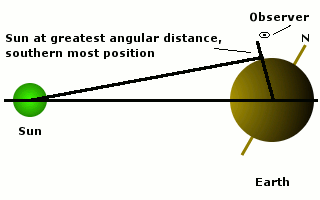
Figure 1: Winter solstice as seen by observer in Northern Hemisphere.
Related links
- Winter solstice 2018: Why pagans celebrate the shortest day of the year (a day late) (20/12/2018)
- Winter Solstice marks 'shortest day and longest night' (18/12/2018)
- Why do mornings still get darker after the winter solstice? (21/12/2014)
- Winter Solstice 2014: Why Google has given the shortest day of the year a doodle (21/12/2014)
- Everything you need to know: December solstice 2014 (18/12/2014)
- Winter Solstice Brings Shortest Day of 2011 This Week (21/12/2011)
- Space.com article explaining the December 2011 winter solstice.
- Winter Solstice 2011: Facts on Shortest Day of the Year (22/12/2011)
- Sky News: Winter solstice sees total lunar eclipse (21/12/2010)
- BBC Radio 4 Today programme: Lunar eclipse coincides with winter solstice (21/12/2010)
- BBC News: Winter solstice at Maeshowe on Orkney" (17/12/2010)
- Shropshire Star: UFO sighting linked to shortest day (07/01/2009)
- BBC News: Hundreds celebrate shortest day (21/12/2008)
| 2023 | June 21 | 14:58 UTC | December 22 | 03:37 UTC |
| 2024 | June 20 | 20:51 UTC | December 21 | 09:20 UTC |
| 2025 | June 21 | 02:42 | December 21 | 15:03 |
| 2026 | June 21 | 08:24 | December 21 | 20:50 |
| 2027 | June 21 | 14:11 | December 21 | 02:42 |